Terrine, Pate, Galantine, Rillettes
Terrine - A terrine in a French term means earthenware. A terrine is a rich, moist and seasoned meat loaf. They are cooked, and covered in a hot water bath (bain marie). After cooking, most meat terrines are left to mature for three or four days. Moreover, a terrine can be based on variety of meats such as chicken, game bird, pork. Also, a terrine can be made from fresh vegetables.
Traditionally, terrines were served from earthenware mold. However, today terrine are sliced served. They are usually served cold or at room temperature.
Preparation of making a terrine
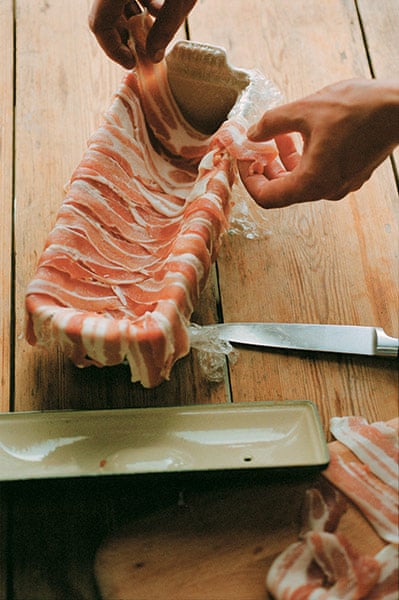
First, preparing the terrine mold by lining fresh pork fatback or caul with will help to keep the mixture moist.
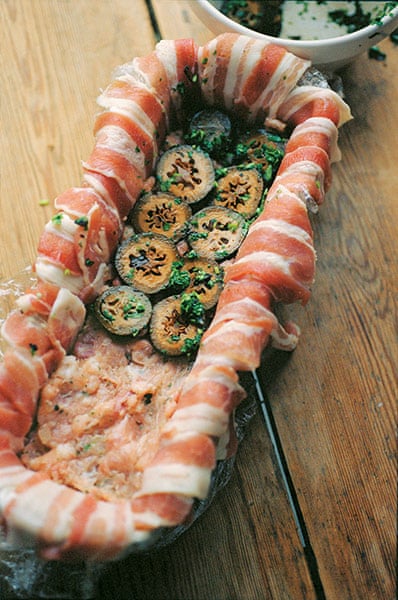
After that, place the forecemeat in layers. Arrange them nicely and evenly.
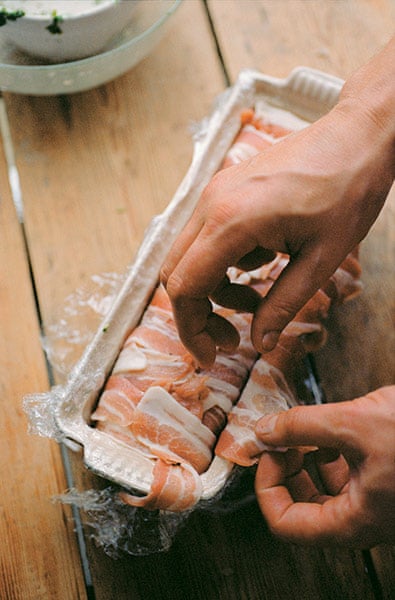
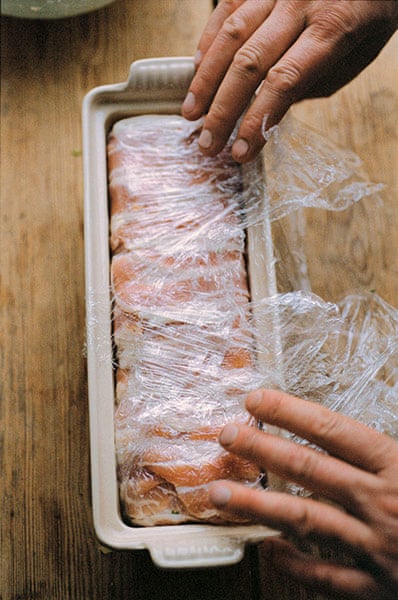
After filling all ingredients in the terrine mold, tightly packed layer of solid meats.
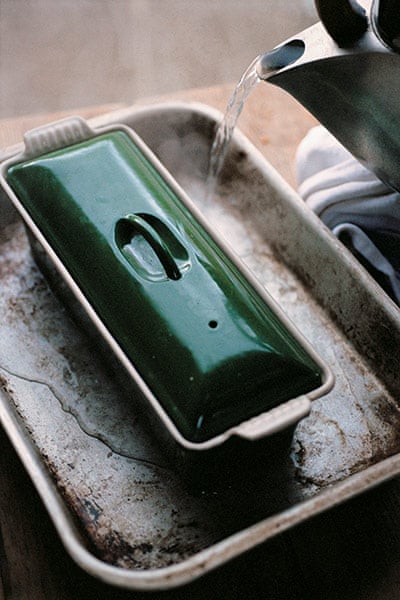
Next, place the terrine in a water bath. Cooked until the internal temperature is desire. Then, cool and store the terrine until ready to serve.
Pate - Pate means wrapped in pastry, so that pate should always be contained within a crust (pate en croute). The cooking method is almost the same as a terrine. Whereas, they are still different. The differences between a pate and a terrine are:
- A pate is a preparation cooked in a crust.
- A pate can be served hot or cold
- A terrine is a preparation cooked directly in a mold. Therefore, the terrine is a product in a mold.
- A terrine has to be serve cold or room temperature.
Pate en croute preparation
Galantines - is de-boned stuffed meat (commonly poultry or fish). A galantines is almost the same as a pate and a terrine, but the cooking method is different. Instead of being cooked in the oven, galantines are poached or roasted, yet it is always served cold.
The 3 steps of making Galantines:


Step 1 - removing skin and bone
The bird skin will be used for wrap the stuff, so making galantines it has to be vitally carefully when remove skin and bones.


Step 2 - Filling and roll galantine
Using the skin from the first step as a wrap; then, filling it with forcemeat and any garnish that you wish.


Step 3 - Prepare the galantine by poaching or roasting
For poaching, add galantine gently in a simmering of water.
For roasting, place galantine on mirepoix or rack; then, uncovered cooked. This will help to reach the internal temperature.
Rillettes - is seasoned meat spread which traditionally made with pork. Rillettes is also called "poor man's pate" because the result is like pate, but it has less cost than other methods. In addition, rillettes are used as spread on crackers, bread, or toast to enrich the flavour.
To make rillettes, cut meat into diced shape or chopped. Then, salting it, and place into the pot. Add some fat and seasoning. The rilletes have to be cooked for 4 to 6 hours or until it is easily to shredded. After cooking, the meat has to be rested in the fridge for three days, for enhancing the flavour and spicy to rillettes. After resting, the rillettes can be kept in the refrigerator for approximately 10 days.
The rillettes is severed at room temperature. Moreover, the rillettes can be made with vegetables, salmon, tuna, etc., and remember that, the rilletes has to be slow-cooked.
Forcemeat
Forcemeat (stuffing meat) are lean meat and fat emulsion that has been finely gridded or chopped, and combine with other ingredients. Forcemeat can be stand alone or used as stuff in other whole meats. Besides, forcemeat has four different types which are Mousseline-style forcemeat, Straight forcemeat, Country-style forcemeat, and Gartin forcemeat. For Country-style and Gartin forcemeat, both of them may need secondary binders. They are three basics of secondary binders: eggs, non fat dry milk powder, and panadas. Panadas are made from starchy items, for example bread soaked in milk, puree rice or potatoes.
Types of Forcemeat
1. Mousseline-style - Poultry, veal and seafood meats are normally used in this type. Meats will be combined with heavy cream and eggs.
2. Straight forcemeat - This is a style of making sausage meat. Meat will be ground finely or will not, it depends on the purpose. It is also used as a basis of pates and terrines.
3. Country-style forcemeat - The processing of making country-style forcemeat is almost the same as straight forcemeat, but meats in this type will not be as fine as straight forcemeat. Meats are coarser.
4. Gartin forcemeat - The meat is seared, cooked, and cooled before being ground. Also, gartin forcemeat is usually contain a secondly binders is called a panade which is mentioned above.
In addition, gartin forcemeat is not often used as straight, mousseline and country-style forcemeat.
Generally forcemeat is consisted of:
40% dominate meat
20% lean meat
40% meat fat
Charcuterie preservation methods (give 3 types and 2 examples of each)
Charcuterie is considered a method of preservation meats. In each method, the result will be different. There are examples for preserving meats:
1. Confit (confee) - Confit means preserve. Confit method is cooking meats with their own fat, then covered and preserved in the same fat. Slow cooking is preferred for this method, and meat is seasoned with salt and herbs to give flavour. For instance, duck confit and chicken confit - legs part are used for making confit.
2. Biltong (dried meat) - is traditionally from South America. The quality of meat and cutting is significant in this method. Meat has to be cut into strip shape and air-dried. British beef is picked to be the best meat for these method, but other meats can be used too, such as pork, ostrich. In this method, meat can be kept up to 3 month in the freezer after being cooked. For example dishes, connoisseur biltong, biltong potjie.
3. Smoking - has two types which are cold and hot smoking. This is one of the methods of preserving meat. For hot smoking method - meat will be cooked and smoked at the same time in the smokehouse. However, cold smoking method need much more longer period of time than hot smoking, approximately 12-24 hours. An example of smoking methods are bacons, hams, etc.
Gelatine
Gelatine is made of animal skins and bones (like pig and cow), so it means that the gelatine is not suitable for vegans. In this blog, I have done my gelatine testing, and this is my first time to work with gelatine.
My ratio of water to gelatine that I used by following:
1 sheet = 2 grams

Types of Forcemeat
1. Mousseline-style - Poultry, veal and seafood meats are normally used in this type. Meats will be combined with heavy cream and eggs.
2. Straight forcemeat - This is a style of making sausage meat. Meat will be ground finely or will not, it depends on the purpose. It is also used as a basis of pates and terrines.
3. Country-style forcemeat - The processing of making country-style forcemeat is almost the same as straight forcemeat, but meats in this type will not be as fine as straight forcemeat. Meats are coarser.
4. Gartin forcemeat - The meat is seared, cooked, and cooled before being ground. Also, gartin forcemeat is usually contain a secondly binders is called a panade which is mentioned above.
In addition, gartin forcemeat is not often used as straight, mousseline and country-style forcemeat.
Generally forcemeat is consisted of:
40% dominate meat
20% lean meat
40% meat fat
Charcuterie preservation methods (give 3 types and 2 examples of each)
Charcuterie is considered a method of preservation meats. In each method, the result will be different. There are examples for preserving meats:
1. Confit (confee) - Confit means preserve. Confit method is cooking meats with their own fat, then covered and preserved in the same fat. Slow cooking is preferred for this method, and meat is seasoned with salt and herbs to give flavour. For instance, duck confit and chicken confit - legs part are used for making confit.
2. Biltong (dried meat) - is traditionally from South America. The quality of meat and cutting is significant in this method. Meat has to be cut into strip shape and air-dried. British beef is picked to be the best meat for these method, but other meats can be used too, such as pork, ostrich. In this method, meat can be kept up to 3 month in the freezer after being cooked. For example dishes, connoisseur biltong, biltong potjie.
3. Smoking - has two types which are cold and hot smoking. This is one of the methods of preserving meat. For hot smoking method - meat will be cooked and smoked at the same time in the smokehouse. However, cold smoking method need much more longer period of time than hot smoking, approximately 12-24 hours. An example of smoking methods are bacons, hams, etc.
Gelatine
Gelatine is made of animal skins and bones (like pig and cow), so it means that the gelatine is not suitable for vegans. In this blog, I have done my gelatine testing, and this is my first time to work with gelatine.
My ratio of water to gelatine that I used by following:
Quantity of water
|
Quantity of gelatine sheets
|
5 minutes
|
1 hour
|
Quantity of gelatine powdered
|
5 minutes
|
1 hour
|
150 ml
|
1 sheet
|
Wobbly
|
Watery
|
2.25 g
|
Watery
|
Watery
|
250 ml
|
1 sheet
|
Firm
|
Watery
|
2.25 g
|
Watery
|
Watery
|
350 ml
|
1 sheet
|
Watery
|
Watery
|
2.25 g
|
Watery
|
Watery
|
1 sheet = 2 grams

For 150 ml of water to gelatine sheet at the first 5 minutes, gelatine seems like firm, but I think it needs more water or time to firm it a little bit more; otherwise, the finishing of product will be very solid. After that, I tested the same amount of water to gelatine powdered, and the result was completely watery.
For 250 ml of water to gelatine sheet at the first 5 minutes, gelatine became firmly, but after an hour, gelatine had already loose firmness. It tear off very easy.
For 300 ml of water to gelatine sheet at the first 5 minutes, gelatine had already become watery, and gelatine powdered also.
Even though I failed to work with gelatine at this time, I learned that the ratio of water to gelatine depends on what types of gelatine are used. The gelatine powdered needs less water than gelatine sheets. Also the processing of making both gelatines is not the same, gelatine powdered has to be sprinkled into cold water; otherwise, it will be lump. On the other hand, the gelatine sheet just put into cold water. Moreover, the water temperature can affect to gelatine result.
Alternative gelatine
The alternative gelatine is used for substitute natural gelatine, and it is suitable for vegans or vegetarians. The optionals for gelatine are:
1. Agar - is used in Asian dessert. It has to be dissolve in the water as well as gelatine, but it needs more time to be set at room temperature about an hour. Besides, after agar is being set, it cannot be stirred or shake; otherwise, it will collapse. This happens because agar has less concentrate than gelatine. Agar can be broken down in high acidity and alkaline, so in high acidity fruit, agar may require higher amount.
2. Carrageenan - is dried seaweed. It is commonly used in ice-creams, mousses, soups. Carrageenan is easily to melt in your mouth. These type of alternative gelatine has to be soak in the water for 12 hours before use. Also, bring it to boil with your liquid before strain it.
3. Vegan Jel - is a versatile alternative gelatine because it can be used in any recipes. In addition, vegan gel has no flavour, also it is easy to use. Just whisk the vegan gel powdered in the cold water until dissolved, it is ready to use.
References
http://www.theguardian.com/lifeandstyle/gallery/2011/sep/30/how-make-terrine-in-pictures
http://www.hertzmann.com/articles/2004/galantine/
http://www.thekitchn.com/vegetarian-and-vegan-substitutes-for-gelatin-tips-from-the-kitchn-189478
https://www.youtube.com/watch?v=KT4NX_8emmI
